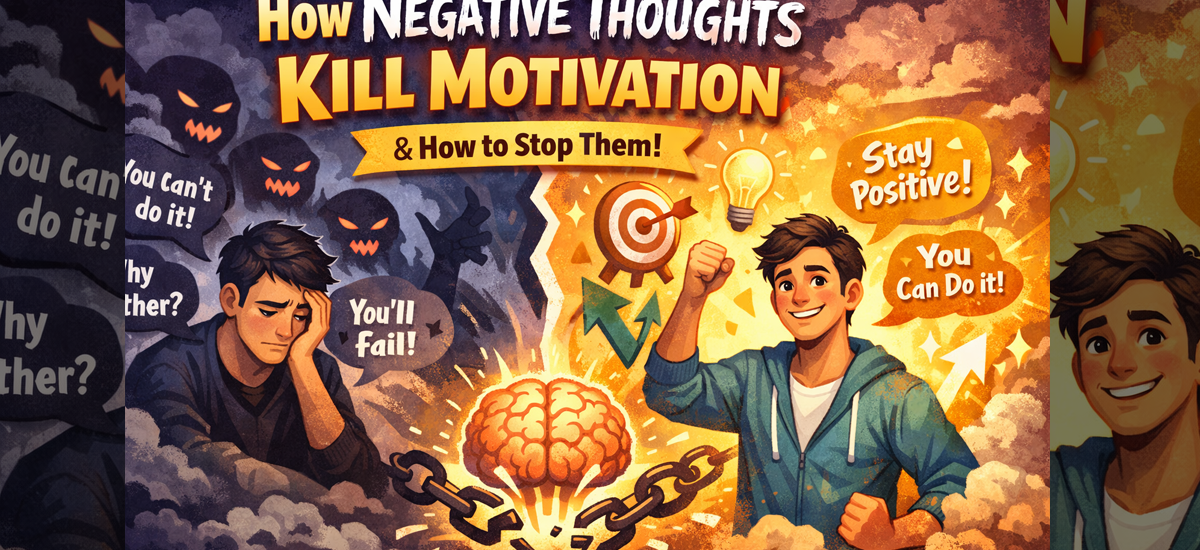
First of all, have you noticed how overthinking slowly turns confidence into self-doubt?
Meanwhile, one negative thought can silently drain your motivation within minutes. As a result, procrastination increases and even simple tasks start feeling difficult. However, most people never realize how negative thoughts control their daily actions.
In fact, repeated negative thinking weakens focus, energy, and self-belief over time. Consequently, motivation fades before real effort even begins. Therefore, understanding this mental pattern becomes essential for personal growth. Most importantly, negative thoughts are habits, not permanent truths. Fortunately, these habits can be changed with awareness and consistent practice.
Finally, this blog explains how negative thoughts kill motivation and how to stop them effectively.
So basically, negative thoughts are self-limiting ideas that reduce confidence and motivation. In simple words, they are mental messages that focus on fear, failure, and self-doubt. Often, these thoughts appear automatically during stress or challenging situations. As a result, they influence emotions, decisions, and daily actions negatively.
Common Examples of Negative Thoughts
3.1 Create Self-Doubt
Negative thoughts slowly reduce belief in your own abilities. As a result, confidence weakens and decision-making becomes difficult.
Because of this, you start questioning every small step you take. Eventually, without self-belief, taking action feels pointless and uncomfortable.
3.2 Lead to Procrastination
Meanwhile, fear of failure increases whenever negative thoughts repeat. Consequently, the mind chooses delay instead of taking immediate action. Over time, postponing tasks becomes a regular habit. Therefore, momentum breaks and motivation continues to fall.
·
3.3 Drain Mental Energy
In addition, constant overthinking consumes mental and emotional energy. As a result, the mind feels tired even without physical work. Because of exhaustion, focus reduces and motivation disappears. Eventually, low energy leads to poor performance and frustration.
·
3.4 Create a Fear Cycle
First, negative thinking creates fear and uncertainty. Then, fear forces you to avoid important actions. After that, avoidance creates guilt and self-blame. Finally, guilt strengthens negative thoughts, continuing the motivation-killing cycle.
First of all, the human brain is designed to protect, not to motivate. Because of survival instincts, the mind focuses more on danger than opportunity. As a result, negative thoughts feel louder and more urgent than positive ones. Meanwhile, past failures leave emotional memories that influence present thinking.
Consequently, the mind recalls mistakes faster than past successes. In addition, social comparison increases self-doubt and unnecessary pressure.
For example, comparing progress with others weakens confidence and motivation. Moreover, lack of clear goals creates confusion and mental uncertainty. Therefore, without purpose, the mind easily drifts toward negative thinking.
Most importantly, this pattern is natural and not a personal weakness. Finally, understanding this helps you respond with awareness instead of self-blame.
Low motivation for small tasks signals mental exhaustion caused by repeated negative thinking. As a result, simple responsibilities feel overwhelming because the mind expects failure or difficulty. Meanwhile, constant comparison creates pressure to meet unrealistic standards set by others. Because of this, confidence drops and self-worth becomes dependent on external validation.
In addition, overthinking begins before starting tasks, increasing fear and mental resistance. Consequently, excessive planning replaces action, delaying progress and increasing frustration. Moreover, fear of taking risks grows stronger due to imagined negative outcomes.
Therefore, opportunities are ignored, even when they could lead to personal growth.
If we recognize these patterns, it helps you regain control over your thoughts and motivation.
6.1 Practice Thought Awareness
First of all, start observing your thoughts instead of automatically believing them. As a result, you create distance between facts and negative assumptions. Meanwhile, writing thoughts down helps identify repeating mental patterns. Because of this, awareness increases and emotional control improves.
6.2 Replace, Don’t Suppress
Instead of fighting thoughts, gently replace them with positive alternatives.
For example, replace “I can’t” with “I’ll try and learn.”
Gradually, one positive replacement builds confidence over time. Therefore, the mind learns a healthier thinking pattern.
6.3 Take Small Actions
Most importantly, action immediately reduces the power of negative thinking. As a result, even five minutes of effort rebuilds momentum.
Meanwhile, small actions create progress without overwhelming the mind. Consequently, motivation grows naturally through movement.
6.4 Control Your Inputs
In addition, reduce exposure to negative news and social media content. Because of this, mental stress decreases and focus improves.
Meanwhile, consuming motivational podcasts and books strengthens positive thinking. Therefore, inputs directly influence your mindset and motivation.
6.5 Build a Positive Routine
Finally, a simple morning routine sets a positive tone for the day. Moreover, regular exercise or walking improves mood and mental clarity. Most importantly, daily gratitude practice trains the mind to notice positives.
Motivation is unreliable because it depends on mood and emotions. However, consistency works even when motivation feels completely absent.
Most importantly, you don’t need motivation to act; action creates motivation. As a result, small consistent actions slowly rebuild confidence and self-belief. Meanwhile, discipline reduces overthinking by focusing on routine, not feelings. Because of this, negative thoughts lose control over daily decisions. In addition, consistency breaks fear by proving progress through repeated effort.
Consequently, the mind stops doubting and starts trusting the process.
Therefore, disciplined action weakens negative thought cycles permanently.
Finally, consistency turns effort into habit and habits into lasting motivation.
Rahul was a student who constantly battled self-doubt and overthinking. No matter what he did, a voice in his head kept telling him he wasn’t smart enough to succeed. Because of this belief, he stopped studying seriously and kept procrastinating on important tasks.
Slowly, negative thoughts took over his mind. They convinced him that even if he tried, nothing would change. As days passed, his motivation faded, and focusing on studies felt impossible.
One day, Rahul decided to do something different. He began noticing and writing down his negative thoughts every day. Instead of fighting them, he observed them calmly. Then came a small but powerful change—he replaced “I can’t do this” with “I’ll try for just five minutes.”
This tiny shift made a big difference. Those five minutes often turned into longer study sessions. Gradually, small actions built confidence, and his focus started improving.
Over time, Rahul felt calmer, more positive, and in control of his thoughts. By changing the way he talked to himself, he rebuilt his motivation and started taking consistent action.
Negative thoughts are a normal part of being human, and everyone experiences them at different stages of life. However, it is important to remember that these thoughts are not facts; they are simply mental reactions shaped by fear, past experiences, and habits. When you start believing every negative thought, motivation slowly fades and action feels harder. Therefore, learning to observe thoughts without accepting them as truth becomes a powerful life skill.
Instead of trying to change everything at once, focus on making small daily improvements that feel manageable and realistic. For example, taking one small action, replacing one negative thought, or following one positive habit can create noticeable change over time. Gradually, these small efforts build confidence, clarity, and inner strength. As consistency grows, motivation begins to return naturally, without force or pressure. Most importantly, progress does not require perfection; it requires patience and persistence. Even on difficult days, showing up in small ways keeps you moving forward. Over time, these daily choices reshape your mindset and create lasting motivation. Finally, trust yourself, stay consistent, and remember that change is always possible, one positive thought and one small action at a time.