
Is Formal Education Still Worth It in 2026?
Do degrees still matter when skills are available everywhere online? In 2026, this is one of the biggest questions students and parents are asking. The cost of formal education continues to rise, while online learning platforms make high-quality knowledge easily accessible. Websites like YouTube, Coursera, Udemy, and skill-based bootcamps allow anyone to learn in-demand skills without spending years in college.
Many students now feel stuck between two choices. One path offers a traditional college degree with structured learning and social recognition. The other promises practical skills, faster career entry, and lower costs. With real-world success stories coming from both sides, confusion has become common. Some fear that skipping a degree may limit future opportunities, while others worry that investing heavily in college may not guarantee a job.
This situation has created a serious discussion about the value of formal education in today’s digital world. When knowledge is just a click away and employers focus more on skills and experience, students are rethinking whether traditional education is still worth the time, money, and effort in 2026.
Section 1:What Formal Education Still Offers
Despite rapid changes in how people learn, formal education continues to hold strong value in 2026. A recognized degree still provides credibility and trust. For many employers, a degree acts as proof that a candidate has completed a verified learning process. It signals consistency, commitment, and the ability to meet academic standards.
Formal education also offers structured learning. Colleges and universities follow a planned curriculum that builds knowledge step by step. This structure helps students develop discipline, time management, and problem-solving habits. These traits often stay useful long after graduation, even outside academic settings.
Campus life provides exposure that online learning cannot fully replace. Students interact with peers from different backgrounds, exchange ideas, and learn through discussions and group work. Networking with classmates, seniors, professors, and alumni often opens doors to internships, referrals, and long-term career opportunities. Peer learning on campus plays a major role in shaping communication skills and confidence.
Some careers still require formal degrees by law or regulation. Professions such as doctors, engineers, lawyers, professors, and architects cannot exist without certified education and licenses. In these fields, formal education is not optional—it is essential.
Education has not disappeared in the digital age. Its purpose has evolved. Instead of being the only path to success, formal education now serves as a foundation that works best when combined with practical skills and real-world experience.
Section 2: The Rise of Skills-Based Careers
Skills-based careers have grown rapidly in recent years, and in 2026 they play a major role in the job market. Online courses, professional certifications, and AI-powered learning tools make it easier than ever to acquire practical skills. Platforms like Coursera, Udemy, Google Certifications, and AI assistants allow learners to study at their own pace and apply knowledge immediately.
Many professionals now choose freelancing, remote jobs, or startup roles instead of traditional employment. These work models focus more on output and results than academic background. Clients and companies care about what a person can do, not where they studied. This shift has created opportunities for skilled individuals who may not have formal degrees.
Several companies now hire based on skills rather than marks or certificates. Hiring managers review portfolios, real projects, and problem-solving ability. Technical tests, task-based interviews, and trial projects have replaced grade-based selection in many industries. This approach helps businesses find talent that can deliver results from day one.
Fields like digital marketing, data analysis, graphic design, coding, UI/UX design, and content creation show this trend clearly. Many professionals in these areas build successful careers through skills, experience, and continuous learning. In such roles, skills often open doors faster than degrees, especially in fast-changing industries driven by technology and innovation.
Section 3: What Employers Actually Care About in 2026
In 2026, employers look beyond certificates and academic scores. The most valued trait is problem-solving ability. Companies want candidates who can analyze situations, think logically, and provide practical solutions. Real challenges at work rarely match textbook examples, which makes independent thinking essential.
Real-world experience and hands-on projects matter more than ever. Internships, freelance work, case studies, and personal projects show how a candidate applies knowledge in practical situations. Employers prefer proof of work over theoretical understanding. A strong portfolio often speaks louder than a high percentage.
Communication skills play a major role in hiring decisions. Employees must explain ideas clearly, collaborate with teams, and interact with clients. Strong written and verbal communication helps reduce errors, improves teamwork, and builds trust in professional environments.
Adaptability and continuous learning have become critical in a fast-changing world. Technology, tools, and job roles evolve quickly. Employers value individuals who can learn new skills, adapt to change, and stay relevant without constant supervision. The ability to grow matters as much as current expertise.
A degree may help a candidate get shortlisted, but performance decides the final outcome. A degree gets you shortlisted; skills get you hired.
Section 4: Degree vs Skills – The Smart Approach
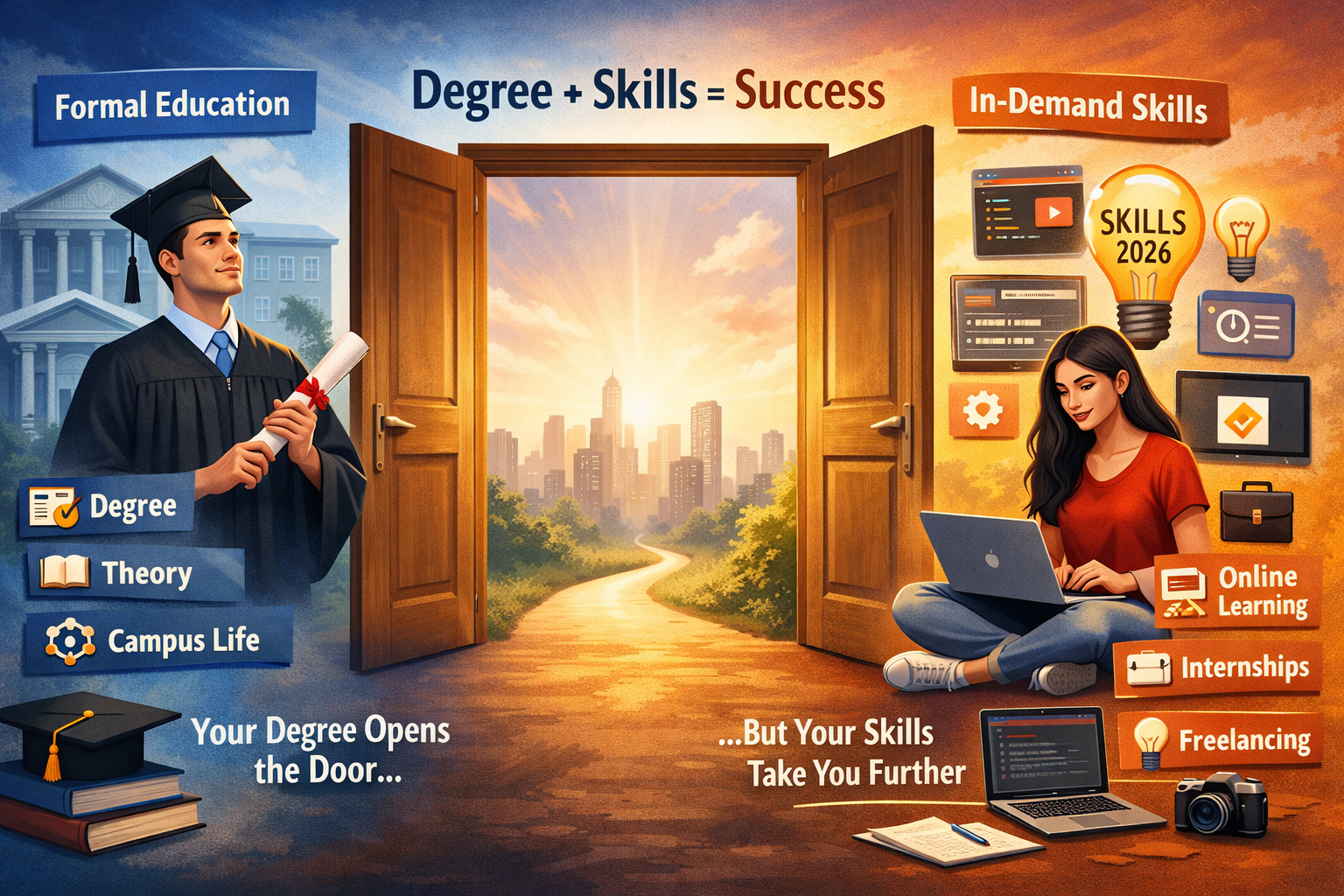
The debate between degrees and skills often misses an important point. The strongest career path in 2026 combines both. A degree provides credibility, foundational knowledge, and long-term stability. Skills add practical value, speed, and job readiness. Together, they create a balanced profile that appeals to employers across industries.
Students do not need to choose one over the other. Skills can be learned alongside formal education. Online courses, workshops, certifications, and AI tools allow students to build practical abilities while completing their degree. Learning skills during college helps students understand how theory works in real situations.
Internships play a key role in this approach. They expose students to workplace expectations, tools, and problem-solving methods. Side projects help convert learning into experience. Building websites, managing social media pages, analyzing data, or creating content strengthens a student’s portfolio. Freelancing during college also helps develop client-handling skills and income awareness.
This combination prepares students for both traditional jobs and modern career paths. A degree opens doors, while skills help students walk through them with confidence. In 2026, the smartest approach is not degree versus skills, but degree with skills.
Section 5: When Formal Education Is NOT Enough
Formal education provides a strong foundation, but in many cases it falls short of real-world requirements. One major issue is outdated syllabus. Many colleges still teach concepts that no longer match current industry needs. Technology, tools, and job roles evolve faster than academic curricula, which creates a gap between education and employment.
Another limitation is theory-heavy learning. Students often spend years memorizing concepts without understanding how to apply them in practical situations. Exams test recall more than problem-solving ability. As a result, graduates may hold degrees but lack job-ready skills.
Lack of practical exposure further reduces the effectiveness of formal education. Many students complete college without working on real projects, using industry tools, or facing workplace challenges. This makes the transition from classroom to career difficult.
The solution lies in taking learning into one’s own hands. Self-learning through online courses, tutorials, and AI tools helps students stay updated. Internships provide exposure to real work environments and professional expectations. Real-world practice through side projects, freelancing, or volunteering builds confidence and experience.
In 2026, formal education alone is often not enough. Students who actively combine academic learning with practical experience gain a clear advantage in the job market.
Conclusion: The Real Value of Education in 2026
Formal education still holds value in 2026. Degrees provide structure, credibility, and access to many career paths. They continue to play an important role in professional growth and long-term stability. However, a degree alone is no longer enough to guarantee success in today’s fast-changing world.
Industries now demand more than academic knowledge. Employers look for problem-solving ability, practical experience, communication skills, and the willingness to keep learning. Those who rely only on their degree often struggle to stay relevant, while learners who upgrade their skills stay ahead.
Success in 2026 belongs to those who take responsibility for their own growth. Continuous learning, real-world practice, and adaptability matter more than certificates. Education has shifted from being a destination to becoming a lifelong process.
In 2026, your degree may open the door—but your skills decide how far you go.
For more, visit more blog posts on site smarthuman.in


