

Best Career Options After 12th: What Students Wish They Knew Before Choosing
Passing 12th class is easy but’ choosing the right future is the real challenge.
Parents want security, relatives suggest familiar paths, friends follow trends, and social media shows only success stories. In between all this noise, students are expected to choose the best career options after 12th—often without fully understanding what those careers actually look like in real life.

This confusion is not a weakness. It is a natural stage. Career decisions today are more complex than ever before because the world of work is changing fast. New jobs are being created, old ones are disappearing, and skills matter as much as degrees. This is why blindly choosing a course or copying someone else’s path often leads to regret.
This article is written with one clear purpose: to help students think clearly, not emotionally. Instead of pushing “top careers” lists, it explains how different career paths actually work, who they are suitable for, and what students should realistically expect in the first 5–10 years. If you are a student or job seeker looking for clarity, not hype, this guide is for you.
Why Choosing the Right Career After 12th Matters More Than Ever
Earlier, career paths were limited and predictable. Today, students have more options—but also more risk. A wrong decision after 12th does not ruin life, but it can waste years, money, and confidence. This is why career planning has become a long-term strategy, not a quick choice.
The biggest mistake students make is assuming that:
- A popular career guarantees success
- A high-paying field will always feel fulfilling
- A degree alone is enough to build a career
- Best career options list after 12th
In reality, careers grow when interest, skills, and opportunity come together. Students who choose thoughtfully often adapt better, learn faster, and recover even if their first plan does not work out.
Before looking at streams and courses, students should ask themselves:
- Do I enjoy learning this subject?
- Am I choosing this for myself or for approval?
- What skills will I gain in 3–5 years?
- Can this career evolve with time?
- Why negative thinking is the biggest enemy of your motivation and growth?
These questions matter more than rankings and trends.

Best Career Options After 12th Science: Reality Beyond the Reputation
Science is often seen as the “safe” or “top” stream, but it comes with high expectations and intense competition. Students who succeed in science-based careers usually have clarity, patience, and long-term commitment, not just good marks.
Medical and healthcare careers like MBBS, nursing, physiotherapy, and allied health sciences demand years of study and emotional resilience. The rewards are respect, stability, and social impact—but progress is slow in the early years. Students who choose medicine only for status often struggle with pressure.
Engineering and technology careers, especially in computer science, AI, data science, and electronics, offer faster growth—but only for those who build real skills. Degrees alone no longer guarantee jobs. Coding ability, problem-solving, internships, and continuous learning decide success.
Pure science and research careers suit students who enjoy deep thinking and academic exploration. These paths are less glamorous initially but build strong authority in teaching, research, and innovation over time.
Science works best for students who enjoy process, not just outcomes.
Best Career Options After 12th Commerce: Stability with Flexibility
Commerce is one of the most balanced streams because it combines structure with adaptability. Students who choose commerce often have multiple exit options, which reduces long-term risk.
Professional courses like CA, CS, and CMA are demanding but highly respected. They require discipline, consistency, and conceptual clarity. Students who stay committed often enjoy strong career stability, authority, and financial security across industries.
Business and management careers through BCom, BBA, and later MBA focus on:
- Decision-making
- Communication
- Strategy
- Leadership
These careers grow faster when students gain internships, practical exposure, and industry understanding early.
Modern commerce careers have expanded into digital roles such as digital marketing, business analytics, finance technology, and e-commerce. These fields reward skill + business sense, making them ideal for students who want growth without rigid paths.
Commerce suits students who want options, not limitations.
Best Career Options After 12th Arts: The Power of Thinking Skills
Arts is often underestimated, but it builds some of the most valuable skills for the future—critical thinking, communication, creativity, and social understanding. These skills are difficult to automate and remain relevant across careers.
Government and civil services careers attract many arts students because they value analytical thinking and general awareness over technical specialization. These roles require patience and long-term preparation but offer authority and impact.
Creative and media careers such as journalism, content writing, design, advertising, and filmmaking depend more on portfolio and consistency than degrees. Students who experiment early and build real work samples grow faster than those who wait for qualifications alone.
Social sciences like psychology, economics, political science, and education lead to careers in teaching, research, policy, and counseling. These fields grow slowly but offer meaningful, purpose-driven work.
Arts works best for students who are curious, expressive, and adaptable.
Skill-Based Careers After 12th: When Learning Beats Labels
Many students today do not fit into traditional academic paths—and that is not a weakness. Skill-based careers offer faster entry into the workforce and global opportunities, especially in digital fields.
Popular skill-based options include:
- Web and app development
- UI/UX and graphic design
- Video editing and content production
- Data analysis and visualization
- Cybersecurity and cloud tools
Vocational careers like hotel management, aviation, fashion, and interior design also perform well when combined with hands-on training and internships.
The advantage of skill-based careers is speed and flexibility. The challenge is discipline. Students must continuously upgrade skills and build portfolios to stay relevant.
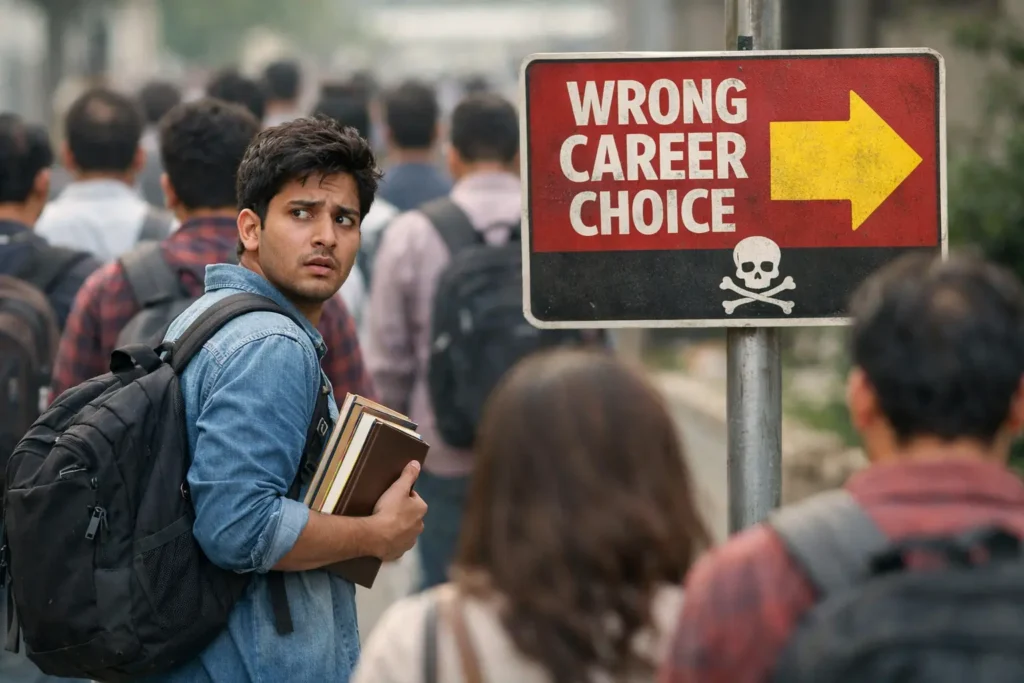
Career Mistakes Students Should Avoid at All Costs
Most career regrets come from avoidable mistakes, not bad luck. Students often underestimate how much early decisions matter.
Common mistakes include:
- Choosing careers only for salary or prestige
- Ignoring personal strengths and interests
- Trusting social media success stories blindly
- Skipping internships and practical exposure
- Assuming career paths are fixed forever
Awareness reduces regret. Exploration reduces confusion.
Practical Career Advice Students Rarely Hear
Career success is rarely instant. It is built through small, consistent steps.
Students should:
- Start career exploration early
- Talk to real professionals, not just toppers
- Build skills alongside degrees
- Accept that clarity improves with experience
- Keep learning even after choosing a path
The goal is not to choose perfectly—but to choose wisely and flexibly.
FAQs: Best Career Options After 12th
Is there a single best career after 12th?
No. The best career depends on individual fit and long-term goals.
Which careers have strong future demand?
Technology, healthcare, finance, education, and digital skills.
Can students change careers later?
Yes. Skills and experience make transitions possible.
Are skills more important than degrees?
Skills drive growth; degrees provide foundation.
How should students take career decisions?
With research, self-awareness, and real exposure.
Final Thoughts: Career Is a Journey, Not a Shortcut
Choosing the best career options after 12th is not about perfection. It is about alignment. When students choose paths that match their interests, skills, and future opportunities, success becomes sustainable.
Careers evolve. People grow. What matters is starting with awareness, not fear.



Nice content