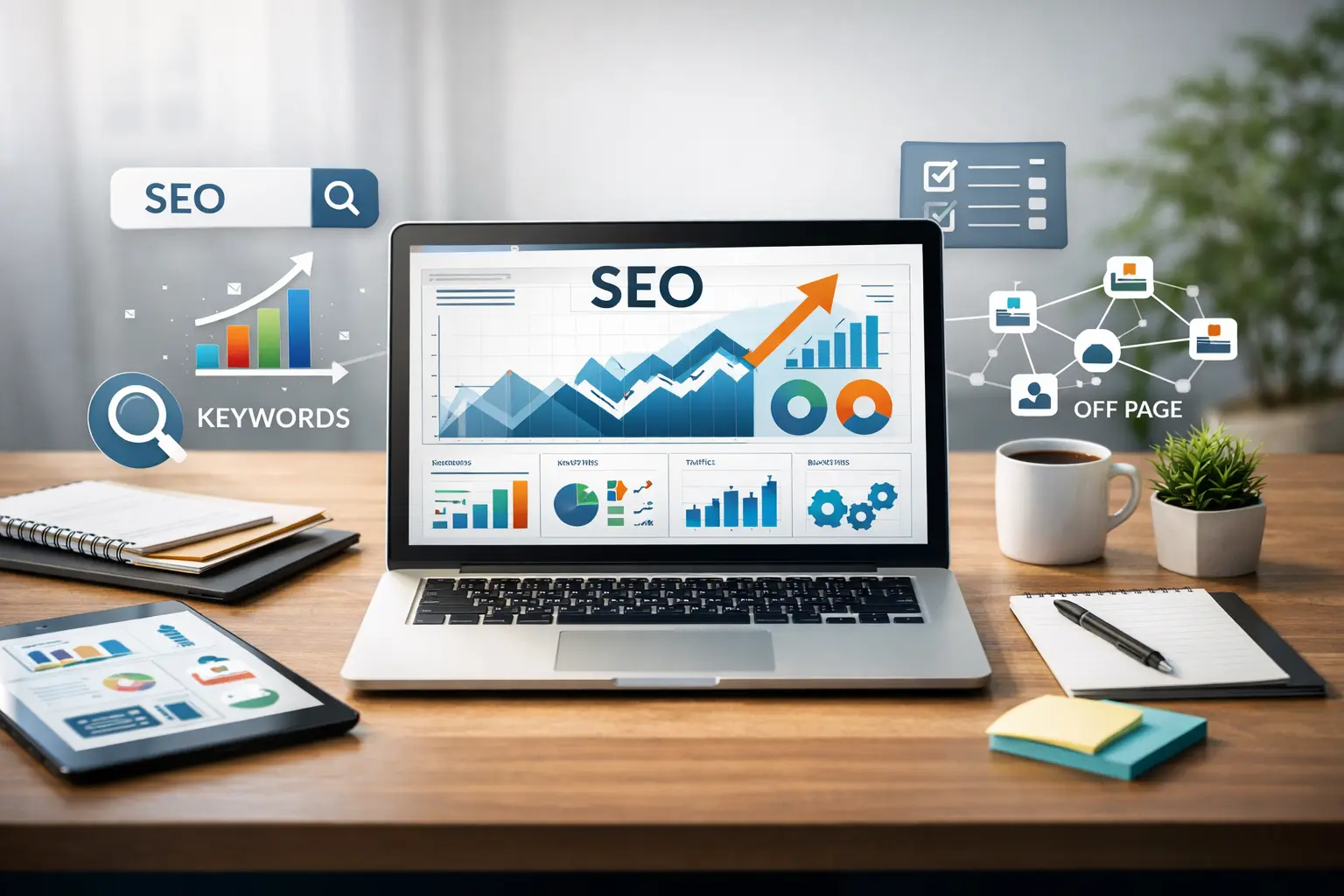
What Is SEO – Search Engine Optimization?
What is SEO: The 10 key takeaway
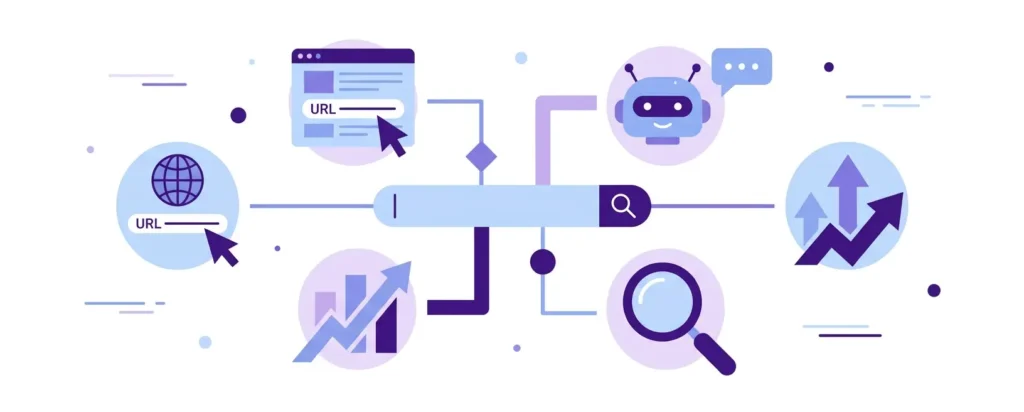
SEO stands for Search Engine Optimization. At its core, it’s the practice of making your website easier for search engines — and the people using them — to find, understand, and trust.
Think of it this way. Every day, billions of people type questions into Google. Google’s job is to show them the most useful, trustworthy, and relevant results. SEO is the work you do to make sure your website qualifies as one of those results — without paying for ads.
Problem-solution Most website traffic either costs money or disappears the moment you stop paying. Organic traffic is different. SEO earns you visitors who find you naturally through search — people who were already looking for what you offer — and unlike ads, that traffic doesn’t stop when a budget runs out.
What SEO involves in practice
- Optimising your content so it answers what people are actually searching for
- Improving your website’s technical performance — speed, mobile experience, and crawlability
- Building authority through backlinks and trust signals
- Structuring content so AI tools can extract and cite it
- Demonstrating real expertise and credibility (E-E-A-T)
How Do Search Engines Work In 2026? What You Need To Know
Before you can optimise for search engines, you need to understand what they actually do. It comes down to three steps.
Crawling
Search engines send out automated bots (called crawlers or spiders) that scan the internet, following links from page to page. These bots discover new content and revisit existing pages to check for updates. If your site is slow, poorly linked, or blocks crawlers, your content might never get found in the first place.
Indexing
Once a page is crawled, the search engine stores and organises it in a massive database called the index. It tries to understand what the page is about — its topic, depth, relevance, and quality. Clear headings, structured content, and schema markup all help search engines categorise your page accurately.
Ranking
When someone searches for something, Google’s algorithm evaluates hundreds of signals — content relevance, page authority, user experience, site speed, and more — to decide which pages appear first. In 2026, this ranking process also feeds into what AI tools cite when they generate answers.
What Is the Role of SEO in Digital Marketing?
A lot of people treat SEO as one tool in a long list of marketing tactics. It’s actually the foundation everything else is built on.
Social media posts go quiet after a few hours. Paid ads stop the moment your budget runs out. A well-optimised blog post, on the other hand, can bring in consistent traffic for years. That compounding return is what makes SEO so valuable for businesses and content creators alike.
SEO also amplifies every other channel you’re investing in. Better visibility builds brand awareness. More organic traffic means more email subscribers. Higher trust signals mean better conversion rates. It’s not a standalone tactic — it’s what makes the whole marketing engine run more efficiently.
4 types of SEO (Search Engine Optimization):
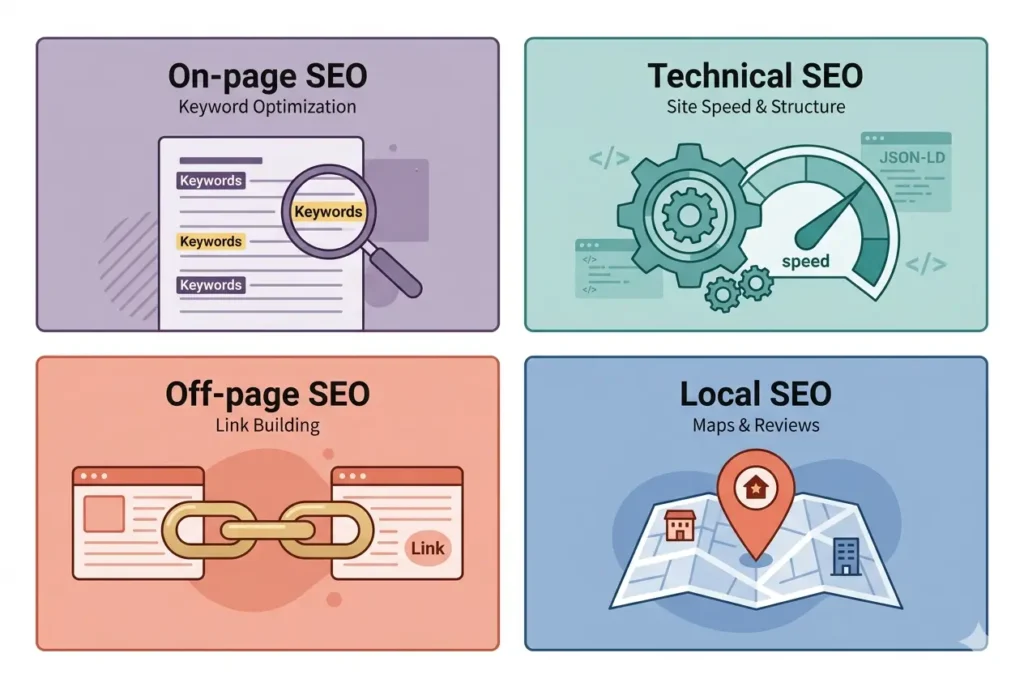
SEO isn’t a single thing. It’s a collection of disciplines that work together. Here’s how to think about each one.
On-page SEO
This is everything you control directly on your own pages — the content, the headings, the keywords, the internal links, and the meta tags. When someone talks about “optimising a blog post,” they’re talking about on-page SEO. It’s the most hands-on part of the job and the best place to start.
Technical SEO
Technical SEO covers the infrastructure of your website — how fast it loads, how well it works on mobile, whether it’s easy for crawlers to navigate, and how its structure signals authority to Google. A beautifully written article on a slow, broken site still won’t rank well.
Off-page SEO
This is about building your website’s reputation in the eyes of search engines — primarily through backlinks. When credible websites link to yours, Google treats it as a vote of confidence. The quality of those links matters far more than the quantity.
Local SEO
If you run a business that serves a specific area — a restaurant, a clinic, a repair shop — local SEO helps you show up when people nearby search for what you offer. It involves optimising your Google Business Profile, getting local citations, and targeting location-based keywords.
On-Page SEO: What It Is and How to Do It
On-page SEO is where most beginners start — and where most of the day-to-day SEO work happens. Let’s walk through the key components.
What is keyword research?
Before you write a word, you need to know what your audience is searching for. Keyword research tells you the exact phrases people type into search engines, how often they search them, and how difficult it is to rank for them.
In 2026, keyword research also includes understanding conversational queries — the natural-language questions people ask AI tools. “What’s the best way to learn SEO for free?” is a different kind of search than “free SEO course,” and both matter.
Tools for keyword research
- Google Keyword Planner — free, great for search volume data
- Ahrefs / SEMrush — comprehensive paid tools for deeper research
- Ubersuggest — beginner-friendly with a free tier
- Google Search Console — shows exactly what queries are bringing people to your site
Content quality and search intent
The single most important thing Google asks about your content is: does it actually help the person who searched for this? That’s search intent — understanding not just what someone searched, but why.
Someone searching “what is SEO” wants a clear explanation. Someone searching “hire SEO agency” wants options to buy. Writing a sales pitch for the first query, or a beginner’s guide for the second, will hurt your rankings no matter how well-written the content is.
Strong SEO content in 2026 also uses what’s called the Answer-First structure. Lead with a clear, direct answer to the main question in the first 100–200 words. Then expand with depth, examples, and evidence. This isn’t just good writing it’s how AI tools decide what to cite.
Technical on-page elements
Title tags
Your title tag is the clickable headline that appears in search results. Keep it under 60 characters, include your primary keyword naturally, and make it genuinely interesting to click. Avoid keyword stuffing — it looks spammy and performs poorly.
Meta descriptions
The short description below your title in search results. It doesn’t directly affect rankings, but it strongly affects whether someone clicks. Write it like an ad — tell the person why your page answers their question better than the others.
Headings (H1 through H6)
Your headings create the structure of your page. Use one H1 — your main title. Use H2s for major sections. Use H3–H6 to break down subsections. This hierarchy helps both readers and search engines understand how your content is organised. It also makes it much easier for AI tools to extract specific answers from your page.
Internal linking
Links between your own pages help search engines understand which content is related and important. They also keep readers on your site longer. Every time you publish something new, look for opportunities to link from older, stronger pages — and link back to your new content from relevant older posts.
Best on-page SEO tools in 2026
- Google Search Console — tracks your rankings, clicks, and indexing status for free
- Ahrefs — deep keyword and backlink analysis
- SEMrush — competitor research and full site audits
- Yoast SEO or Rank Math — WordPress plugins that guide on-page optimisation in real time
- Surfer SEO — analyses top-ranking pages and tells you what your content needs to compete
What is the E-E-A-T framework?
If there’s one framework that defines modern SEO quality signals, it’s E-E-A-T. It stands for Experience, Expertise, Authoritativeness, and Trustworthiness — and it shapes how Google evaluates whether your content deserves to rank.
Experience
Does the content show first-hand experience? A travel blog post written by someone who actually visited the destination carries more weight than one compiled from other websites. Include personal insights, real examples, and genuine perspectives — not just summarised information.
Expertise
Is the content written by someone who genuinely knows the subject? For topics like health, finance, or legal advice, expertise matters enormously. For other topics, depth and accuracy signal expertise just as strongly as credentials.
Authoritativeness
Is your website and the author recognised as a credible source in your field? Backlinks from respected sites, author bios linking to LinkedIn or published work, and mentions across the web all contribute to this.
Trustworthiness
Can users trust your site? This includes having an HTTPS connection, a clear privacy policy, honest and accurate content, and transparent contact information. For ecommerce sites, it includes things like clear refund policies and genuine reviews.
Practical ways to improve your E-E-A-T signals
- Add a detailed author bio to every article, with a link to a LinkedIn profile or portfolio
- Cite reputable external sources (government sites, academic papers, industry reports)
- Include a publication date and update date on every post
- Share content on platforms where your audience already trusts you
- Keep content factually accurate and correct errors quickly when they appear
Are Core Web Vitals a ranking factor?
You can write the best content in the world, but if your website is slow, broken on mobile, or impossible for crawlers to navigate — none of it matters. Technical SEO is the behind-the-scenes work that makes everything else possible.
Core Web Vitals — the metrics that actually matter
Google uses a set of measurable performance signals called Core Web Vitals. In 2026, these three metrics are the ones to focus on:
INP (Interaction to Next Paint) — target: under 200ms
INP measures how quickly your page responds when a user interacts with it — clicking a button, opening a menu, submitting a form. It replaced the older FID metric in 2024 and is now a core ranking signal. If your site feels “laggy” when people use it, your INP score is likely the problem.
LCP (Largest Contentful Paint) — target: under 2.5 seconds
LCP measures how long it takes for the largest visible element on your page to load — usually your hero image or main heading. Slow LCP is one of the most common reasons pages underperform. Compress images, use a CDN, and reduce server response times.
CLS (Cumulative Layout Shift) — target: under 0.15
CLS measures visual stability — how much the page layout jumps around as it loads. If you’ve ever tried to click a link only to have an ad load and push it out of the way, you’ve experienced bad CLS. Always specify image dimensions in your HTML, and avoid inserting content above existing elements after the page loads.
How to measure your Core Web Vitals
- Google Search Console (Performance > Core Web Vitals) — free, site-wide data
- Google PageSpeed Insights — page-level analysis with specific recommendations
- GTmetrix — detailed waterfall analysis to identify slow elements
What Is Schema Markup And How To Implement It
Schema markup is code you add to your website to give search engines structured information about your content. Think of it as a label that tells Google: “This section is a FAQ,” “This page is a recipe,” or “This content was written by this expert on this date.”
In 2026, schema markup has become especially important for AI visibility. Google’s AI Overviews heavily pull from pages with structured data because it makes the content much easier to parse and cite accurately.
FAQPage schema
If your page has a FAQ section, mark it up with FAQPage JSON-LD. Each question and answer becomes a directly extractable unit that Google can surface in AI Overviews and rich snippets. This is one of the highest-impact schema changes you can make on an informational article.
Article schema
Add Article schema to every blog post. It tells Google the title, author, publication date, and modification date. Keeping the dateModified field current signals that your content is being actively maintained — which helps with both rankings and AI citations.
How To schema
For any step-by-step content, HowTo schema is excellent. It makes each step independently extractable, which AI systems can reference when answering process-oriented questions.
How to build strong backlinks?
A backlink is a link from another website to yours. Search engines treat these as votes of confidence — and the more credible the source, the more valuable the vote.
One strong backlink from a reputable industry publication is worth more than a hundred links from low-quality directories. In 2026, this is truer than ever — Google has gotten much better at detecting link schemes and manipulative practices.
How to earn quality backlinks legitimately
- Guest posting — write genuinely useful articles for relevant publications in your niche
- Original research — publish data, surveys, or studies that other people want to cite
- Resource pages — create truly comprehensive guides that earn links naturally over time
- HARO and media mentions — respond to journalist requests for expert sources
- Broken link building — find broken links on other sites and offer your content as a replacement
Note: In 2026, unlinked brand mentions also carry weight with AI systems. Being talked about on Reddit, podcasts, and industry forums — even without a direct link — builds the kind of entity recognition that influences how AI tools perceive your brand.
GEO: The New Layer on Top of SEO You Can’t Ignore in 2026
This is the section that separates a 2024 SEO guide from a 2026 one.
Generative Engine Optimization (GEO) is the practice of structuring and writing your content so that AI-powered search tools — Google AI Overviews, ChatGPT, Perplexity, Gemini, and others — can understand, extract, and cite it when answering user questions.
Some context on why this matters: research suggests that over 90% of queries answered by AI Mode result in zero website clicks. Users get the answer directly in the interface. But here’s the flip side — if your brand is the source being cited, you’re getting brand exposure to everyone who reads that answer. Over time, that recognition compounds.
GEO doesn’t replace SEO. It builds on top of it. Sites with strong traditional SEO foundations are also the ones most likely to earn AI citations — because the same signals that help you rank (relevance, authority, structure, accuracy) also make your content citation-worthy.
SEO vs GEO vs AEO — what each one optimises for
| SEO | GEO | AEO | |
| Goal | Rank in search results | Get cited in AI answers | Appear in direct answer boxes / voice |
| Key metric | Rankings, organic traffic | Citation rate, share of synthesis | Featured snippet rate |
| Best for | Driving clicks to your site | Brand awareness, authority | Voice search, zero-click queries |
| Core tactic | Keywords, backlinks, content quality | Answer-first structure, schema, E-E-A-T | FAQ format, concise direct answers |
How to optimise your content for GEO
Use the Answer-First content structure
AI systems evaluate a page’s relevance largely based on its opening content. Your first 150–200 words should directly and completely answer the primary question your article addresses. Then expand with depth and supporting evidence. This structure works for both human readers and AI retrievers.
Write atomic answer blocks
Atomic answers are self-contained paragraphs of 40–60 words that give a complete, citable answer to a specific sub-question. Use a clear question as your heading (H2 or H3), then follow it immediately with a short, definitive paragraph. AI tools can extract and quote these directly — which is exactly what you want.
Include cited statistics and original data
Content with verifiable data points gets cited significantly more often by AI systems than opinion-only content. If you can publish original research — a survey, a case study, a dataset — that becomes a citation magnet for other writers and for AI tools alike.
Refresh content regularly
AI retrieval systems prioritise recent content. Updating your article — adding new sections, correcting outdated information, updating your schema’s dateModified field — signals that your content reflects the current state of the topic. This directly increases how often AI tools pull from your page versus a competitor’s older version.
The Complete SEO Workflow: Step by Step
Here’s a practical, sequential approach you can apply right now — whether you’re starting from scratch or refreshing existing content.
- Keyword research — identify what your audience is searching for and why
Use tools like Google Search Console, Ahrefs, or Ubersuggest. Look for keywords with clear search intent that your content can genuinely answer better than what currently ranks.
- Create genuinely helpful content with an Answer-First structure
Lead with your best answer. Use clear headings (H1 through H6). Break complex ideas into digestible sections. Aim for depth and accuracy over word count.
- Apply on-page optimisation
Optimise your title tag and meta description. Place your primary keyword in your H1, first paragraph, and a few H2s naturally. Add descriptive alt text to images. Link to relevant internal pages.
- Add schema markup (JSON-LD)
Add Article schema with author details and publication date. If you have FAQs, add FAQPage schema. If you have steps, add HowTo schema. This makes your content AI-extraction-ready.
- Fix technical issues
Check Core Web Vitals in Google Search Console. Compress images. Fix broken links. Ensure the site is fully mobile-responsive. Verify Google can crawl and index your pages.
- Build links and mentions
Reach out to relevant publications for guest posts. Share your content where your audience actually is. Build relationships with other creators in your space.
- Track, measure, and iterate
Use Google Search Console to monitor rankings and impressions. Use GA4 to track traffic and user behaviour. Update content when it starts to decay — adding new sections, refreshing outdated information, and updating your dateModified schema.
The Real Benefits of SEO
People often underestimate SEO because the results take time. But that slow build is also its greatest strength.
- Free, compounding traffic — every article you publish can continue driving visitors for years
- Reduced ad spend — as organic traffic grows, you rely less on paid channels
- Brand credibility — appearing on page one of Google signals authority to new audiences
- AI visibility — well-structured, authoritative content gets cited in AI-generated answers
- Better user experience — SEO improvements almost always make the site better for real users too
- Higher conversions — organic visitors who find you through relevant searches convert better than cold ad traffic
Practical SEO Examples Across Different Contexts
A blogger building an audience
A personal finance blogger writes a detailed guide on budgeting for beginners. They use clear H2 and H3 headings, add an FAQ section with JSON-LD schema, and cite official government statistics. Within six months, the post ranks on page one for several long-tail keywords — and gets cited in Perplexity answers about budgeting apps. Traffic grows without any paid promotion.
A local business attracting nearby customers
A dental clinic optimises their Google Business Profile, adds location-specific pages for each service, and earns five-star reviews. When someone in their city searches “teeth whitening near me” on Google or asks an AI assistant for recommendations, they appear prominently.
An ecommerce store growing organic sales
An online shoe store optimises each product page with unique descriptions, customer reviews, Product schema markup, and clear category navigation. Organic traffic to product pages grows month over month, reducing dependence on paid ads. Google AI Overviews begin surfacing specific products in response to comparison queries.
Expert Tips for SEO Beginners in 2026
- Start with one pillar article, do it exceptionally well, then branch out
- Write for real people first — if a human finds it confusing, so will Google
- Set up Google Search Console on day one — it’s free and invaluable
- Update old content — a refreshed article often outperforms a brand new one
- Don’t chase every algorithm update — focus on quality and the fundamentals hold up
- Study the pages that already rank for your target keyword — understand why, then do it better
- Learn GEO alongside SEO — both skill sets are now essential for modern content creators
Frequently Asked Questions About SEO
What is SEO in simple words?
SEO means improving your website so it shows up higher when people search for topics you cover. It’s how you attract visitors from Google — and AI tools — without paying for ads every time someone clicks.
What is GEO and how is it different from SEO?
SEO gets you ranked in Google’s list of links. GEO (Generative Engine Optimization) gets you cited inside AI-generated answers from tools like ChatGPT, Perplexity, and Google AI Overviews. They use many of the same foundations — quality content, strong authority, good technical structure — but GEO requires you to also think about extractability, atomic answers, and structured data.
How long does SEO take to show results?
It depends on your site’s existing authority and competition level. A new site typically takes 4–12 months to see meaningful organic traffic. Technical improvements can show quick wins (weeks), content gains build over months 2–4, and domain authority grows over 6–12+ months. GEO citations can appear faster — sometimes within weeks of publishing well-structured content.
What is on-page SEO?
On-page SEO is the work you do directly on your webpages to improve their rankings — writing quality content, using keywords naturally, structuring headings clearly, optimising images, and creating internal links. It’s the area you have most direct control over.
What are SEO backlinks and why do they matter?
Backlinks are links from other websites pointing to yours. Search engines treat them as signals of credibility — the more reputable the source, the more valuable the link. High-quality backlinks help improve your domain authority and ranking position. In 2026, unlinked brand mentions also influence how AI systems perceive your credibility.
Can beginners do SEO without technical knowledge?
Yes. Most on-page SEO is achievable without coding skills, especially using tools like Yoast SEO or Rank Math on WordPress. Technical SEO gets more complex, but basic improvements — page speed, mobile responsiveness, fixing broken links — are manageable with guidance. Start with content quality and on-page fundamentals, then build your technical knowledge gradually.
What are Core Web Vitals and do they affect rankings?
Core Web Vitals are Google’s set of performance metrics — INP (responsiveness), LCP (loading speed), and CLS (visual stability). Yes, they affect rankings. Google uses them as part of its Page Experience signals. Check them in Google Search Console or Google PageSpeed Insights for free.
Conclusion: SEO in 2026 Is Bigger Than Ever — and More Accessible Than You Think
SEO isn’t a hack. It’s not a shortcut. It’s the long game — and it’s one of the highest-ROI investments you can make in a website, a blog, or a business.
In 2026, the fundamentals haven’t changed — create genuinely useful content, build real authority, keep your site technically sound, and be consistent. What’s new is the layer on top: AI is now a gateway to information, and the brands that understand GEO alongside traditional SEO will have a significant edge. Start where you are. Pick one improvement from this guide and implement it today. Then come back for the next one. That’s how durable organic growth actually happens — not in a burst, but one well-executed step at a time