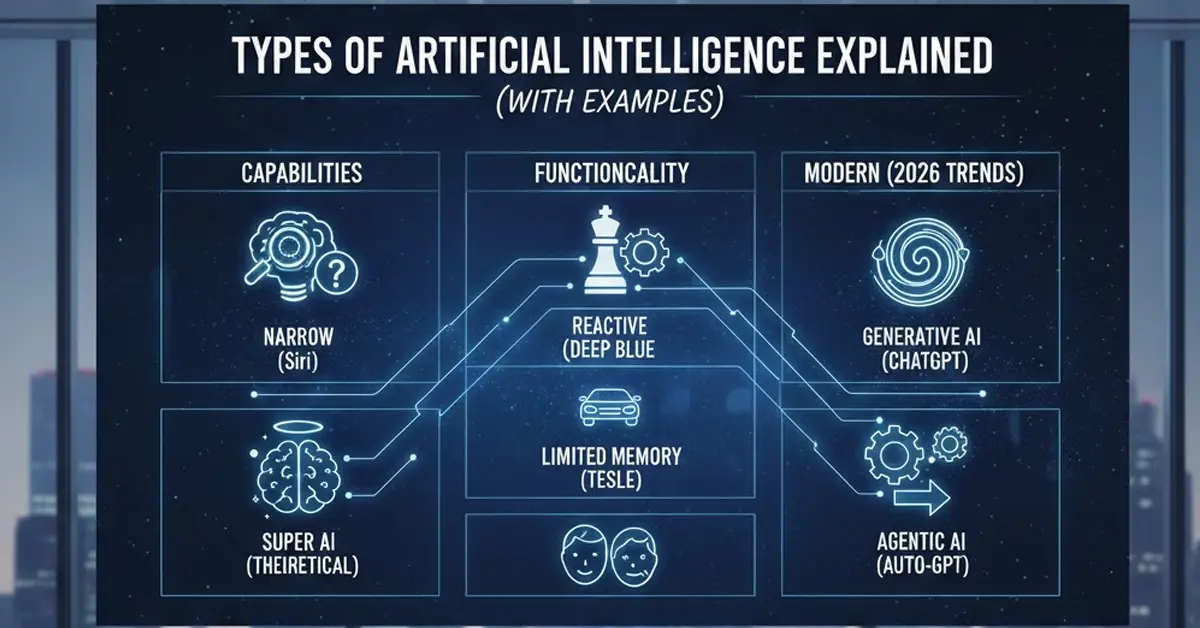
Types of Artificial Intelligence Explained (With Examples)
Introduction
Artificial Intelligence is transforming the way we live, work, and interact with technology. From voice assistants like Alexa and Siri to recommendation systems on Netflix and advanced self-driving cars, AI is becoming a part of our everyday lives. However, not all AI systems are the same — they are categorized based on their capabilities and functionalities. In this article, “Types of Artificial Intelligence Explained (With Examples)”, we will break down the different types of AI in simple terms, understand how they work, and explore real-world examples to make each concept clear and practical.
Artificial Intelligence is no longer a futuristic concept — it is everywhere today. From smart assistants and chatbots to personalized recommendations and self-driving technology, AI quietly powers many tools we use daily. Yet, many people don’t realize that AI is not just one single technology; it has different types, each designed for specific purposes. These types are generally classified based on capabilities and functionality. Understanding these categories helps you see how AI actually works behind the scenes. In this guide, you’ll learn the main types of AI in a simple and practical way, along with clear examples to make each concept easy to understand.
Types of AI Based on Capabilities
Artificial Intelligence can be categorized based on its capabilities, meaning how intelligent it is compared to humans. There are three main types: Narrow AI, General AI, and Super AI.
1. Narrow AI (Weak AI)
Definition:
Narrow AI is a type of artificial intelligence designed to perform a specific task or a limited range of tasks. It operates under predefined rules and cannot go beyond its programmed functions.
Key Characteristics:
- Focused on a single task
- Cannot think or reason outside its training
- Works within a limited domain
- Most common type of AI today
Real Examples:
- Siri and Alexa (voice assistants)
- Google Search
- Netflix and Amazon recommendation systems
- Spam email filters
👉 Almost all AI systems we use today fall under Narrow AI.
2. General AI (Strong AI)
Definition:
General AI refers to a theoretical form of AI that can understand, learn, and apply knowledge across multiple tasks, similar to human intelligence.
Key Characteristics:
- Can perform any intellectual task a human can
- Has reasoning and problem-solving abilities
- Learns and adapts across different domains
- Not yet fully developed
Real Examples:
- Currently, no true real-world example exists
- AI shown in movies like Iron Man’s JARVIS is a fictional representation
👉 General AI is still under research and development.
3. Super AI
Definition:
Super AI is a hypothetical type of AI that would surpass human intelligence in all aspects — including creativity, decision-making, and emotional understanding.
Key Characteristics:
- More intelligent than humans
- Self-aware and independent
- Capable of advanced reasoning and strategic thinking
- Completely theoretical at present
Real Examples:
- No real-world examples exist
- Often portrayed in science fiction movies like The Matrix or Ex Machina
👉 Super AI remains a concept discussed in research and future predictions.
Types of AI Based on Functionality
Artificial Intelligence can also be classified based on its functionality, meaning how it processes information and responds to situations. Unlike capability-based classification, this approach focuses on how AI systems behave and interact with their environment. Some AI systems only react to current inputs, while others can store memories or even understand emotions. Understanding the types of AI based on functionality helps you see how different AI models operate and how advanced they truly are in real-world applications.
1.Reactive Machines
Meaning:
Reactive Machines are the most basic type of Artificial Intelligence. They can only respond to current inputs and do not store memories or learn from past experiences. They react to situations in real time based on predefined rules.
Explanation (Easy to Understand):
- They do not have memory.
- They cannot learn from past experiences.
- They only respond to present data.
- They follow fixed rules or algorithms.
- They cannot improve their performance over time.
Real Example:
- IBM’s Deep Blue – The chess-playing computer that defeated world champion Garry Kasparov. It analyzed the current board position and made the best possible move but did not learn from previous games.
2. Limited Memory AI
Limited Memory AI
Meaning:
Limited Memory AI is a type of artificial intelligence that can use past data or experiences for a short period to make better decisions. Unlike simple reactive machines, it can learn from historical information, but it does not store memories permanently like humans.
Explanation (Easy Points):
- Uses past data to improve current decisions
- Learns from historical patterns and experiences
- Memory is temporary or task-specific
- Commonly used in modern AI applications
- Cannot develop full self-awareness
Real Examples:
- Self-driving cars (analyze past traffic data and road conditions)
- Chatbots that remember previous messages during a conversation
- Recommendation systems like Netflix and Amazon
- Fraud detection systems in banking
👉 Most modern AI systems today fall under Limited Memory AI.
3.Theory of Mind AI
Meaning:
Theory of Mind AI is a type of artificial intelligence that would be able to understand human emotions, beliefs, intentions, and thoughts. It would not only process data but also recognize and respond to people’s feelings and social cues — similar to how humans understand each other.
Explanation (Easy Points):
- Understands human emotions and behavior
- Recognizes intentions, beliefs, and social signals
- Adapts responses based on emotional context
- Would interact more naturally with humans
- Still under research and not fully developed
Real Examples:
- No fully developed real-world example exists yet
- Advanced social robots under research are early steps toward this type
- Fictional examples include highly intelligent AI characters in movies
👉 Theory of Mind AI is still a developing concept and represents the next big step in human-like artificial intelligence.
4.Self-Aware AI
Meaning:
Self-Aware AI is a hypothetical type of artificial intelligence that would possess its own consciousness, emotions, and sense of identity. It would not only understand human emotions (like Theory of Mind AI) but also have awareness of its own internal states, thoughts, and existence.
Explanation (Easy Points):
- Has its own consciousness and self-awareness
- Understands its own emotions and thoughts
- Can make independent decisions beyond programming
- Potentially more intelligent than humans
- Completely theoretical and does not exist today
Real Examples:
- No real-world examples exist
- Often shown in science fiction movies like Ex Machina or The Matrix
👉 Self-Aware AI remains a future concept and is currently beyond the capabilities of modern artificial intelligence.
Comparison Table (Important for SEO)
| AI Type | Exists Today | Example | Intelligence Level |
| Narrow AI (Weak AI) | ✅Yes | Siri, Google Search, Netflix recommendations | Performs one specific task only |
| General AI (Strong AI) | ❌ No (Still in research) | Not available yet | Can think and learn like a human |
| Super AI | ❌ No (Future concept) | Not developed | Smarter than humans in all areas |
| Reactive Machines | ✅ Yes | IBM Deep Blue (Chess AI) | Reacts only to current situation |
| Limited Memory AI | ✅ Yes | Self-driving cars, ChatGPT | Learns from past data to improve decisions |
| Theory of Mind AI | ❌ No (Under development) | Experimental systems | Can understand human emotions |
| Self-Aware AI | ❌ No (Does not exist) | None | Has consciousness and self-awareness |
Real-World Applications of Artificial Intelligence
Healthcare
- AI helps doctors detect diseases like cancer at early stages using medical imaging analysis.
- Hospitals use AI systems to predict patient risks and suggest personalized treatment plans.
- Chatbots assist patients by answering basic health questions and scheduling appointments instantly.
- AI speeds up drug discovery by analyzing large medical data faster than humans.
Finance
- Banks use AI to detect fraudulent transactions by monitoring unusual spending patterns in real time.
- AI-powered chatbots help customers check balances, transfer money, and resolve issues quickly.
- Investment platforms use AI algorithms to suggest smart investment options based on user profiles.
- Credit scoring systems analyze financial history to decide loan approvals more accurately.
Marketing
- AI analyzes customer behavior to create personalized product recommendations and targeted advertisements.
- Email marketing tools use AI to send messages at the best time for engagement.
- Businesses use AI tools to analyze social media trends and customer sentiment.
- Chatbots improve customer experience by providing instant responses on websites and apps.
Education
- AI-powered platforms provide personalized learning experiences based on student performance.
- Online learning apps use AI to recommend courses according to interests and progress.
- Automated grading systems save teachers time by evaluating assignments efficiently.
- Virtual tutors assist students by explaining difficult topics in simple ways.
E-Commerce
- AI recommends products based on previous searches and purchase history.
- Online stores use AI chatbots to handle customer queries 24/7 without delay.
- Dynamic pricing systems adjust product prices based on demand and competition.
- AI improves inventory management by predicting which products will sell faster.
Conclusion
Artificial Intelligence is already transforming major industries like healthcare, finance, marketing, education, and e-commerce. It helps doctors detect diseases faster, banks prevent fraud, marketers personalize advertisements, teachers offer customized learning, and online stores recommend products intelligently.
In simple words, AI is mainly used to analyze data, predict outcomes, automate tasks, and improve user experience across industries.
What are the types of artificial intelligence?
The types of AI are based on :- capabilities and functionality.
How many types of AI still exists today?
There are three types of AI that still exists today:- Narrow AI , Reactive Machines and Limited Memory AI.
How AI is used in real life?
AI is now used in different fields such as Healthcare, finance, e-commerce, marketing etc.