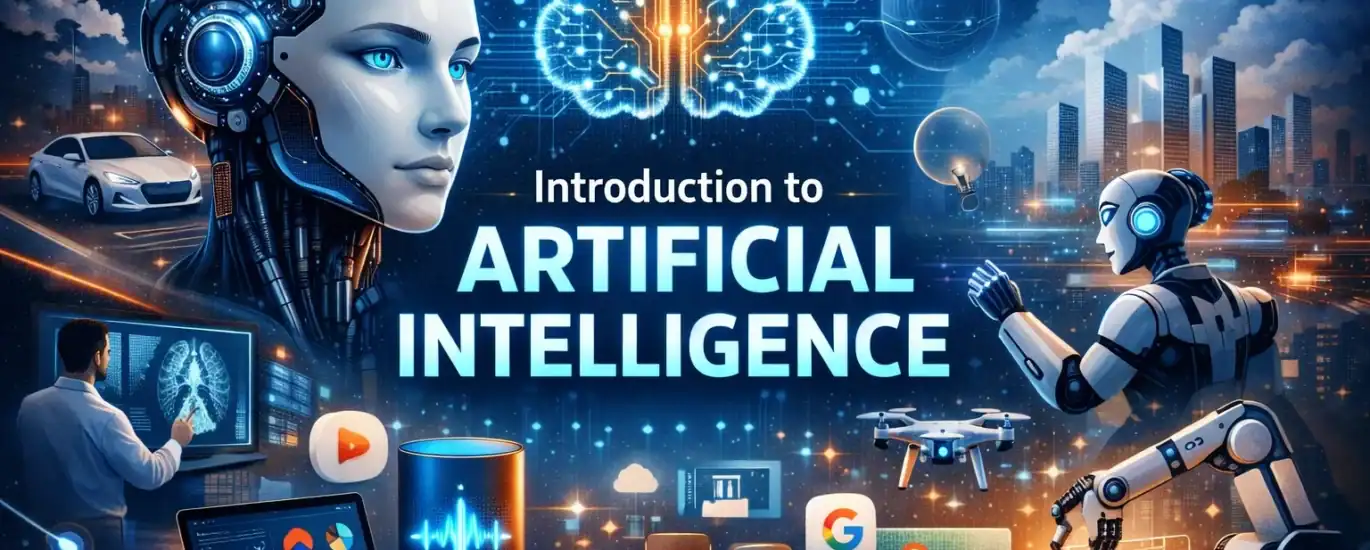
Artificial Intelligence (AI) is no longer just a concept from science fiction; it is a transformative technology that is reshaping how we live, work, and communicate. At its core, AI refers to computer systems designed to simulate human intelligence. It performs tasks like problem-solving, recognizing speech, and making data-driven decisions with incredible speed. From the personalized recommendations on your favourite streaming apps to the advanced chatbots powering modern customer service, AI is the invisible engine driving the next generation of digital innovation. In this post, we’ll explore why it has become the most important tool of the 21st century.
Artificial Intelligence (AI) is a branch of computer science that builds smart systems capable of performing tasks that typically require human intelligence. Instead of following a strict set of manual rules, AI uses advanced algorithms and vast amounts of data to learn, reason, and solve problems. From the facial recognition on your phone to the personalized recommendations on Netflix, AI is the technology that allows machines to perceive their environment and make data-driven decisions. By mimicking human cognitive functions like speech recognition and pattern identification, AI helps automate complex processes. Thus making our daily lives more efficient and connected.
One of the best real-life examples of Artificial Intelligence is the recommendation engine used by platforms like Netflix or Amazon. Every time you see a “Recommended for You” list, you are interacting with a complex AI system. These algorithms analyze your past behavior—such as the movies you’ve watched, the items you’ve searched for, and even how long you hovered over a specific title. So it predict what you will enjoy next. By processing millions of data points across their entire user base, these AI systems can provide a hyper-personalized experience that feels like it was hand-picked by a friend, helping businesses increase engagement while saving you time on searching.
To understand how Artificial Intelligence works, think of it as a three-step cycle: data input, pattern recognition, and decision-making. First, AI systems are fed massive amounts of information—everything from text and images to complex numbers. Next, the AI uses algorithms (sets of mathematical rules) to scan that data for hidden patterns or trends that a human might miss. Finally, once the system identifies these patterns, it uses them to make a prediction or complete a task, such as suggesting a movie you’ll like or detecting a fraudulent credit card charge. Unlike traditional software that only follows rigid “if-then” instructions, AI “learns” and improves its accuracy over time as it processes more data.
To truly understand AI, you can think of its development as a journey from specific tools to human-like brains, and eventually to superhuman intelligence.
As an expert in the field, here is a detailed breakdown of these three levels.
Narrow AI is “specialized” intelligence. It is programmed to excel at a single, defined task by processing massive amounts of data within a specific framework. It cannot “think” outside its box; a Narrow AI that plays Chess cannot suddenly decide to write a poem.
AI uses Machine Learning and Neural Networks to identify complex data patterns. It doesn’t “understand” tasks like humans do; instead, it calculates the highest probability of a correct answer. By processing vast training datasets, AI becomes a sophisticated prediction engine for text, images, and media.
Even advanced models like Gemini 3 or GPT-4o are classified as Narrow AI. While they seem “general” due to their conversational range, they are specialized for specific outputs. They excel at predicting the next word or pixel but lack true human-like consciousness or multi-domain reasoning.
General AI is the level where a machine possesses the same cognitive flexibility as a human. It can learn a new language, solve a physics problem, and navigate a social situation—all without needing separate programming for each task.
Super AI is a theoretical state where AI doesn’t just match humans—it leaves us behind. It would be able to process the entire sum of human knowledge in seconds and think in ways that are physically impossible for a biological brain.
AI is now an essential part of our daily routines through facial recognition and personalized recommendations. Netflix and Amazon use AI to suggest content tailored specifically to your unique interests. Google Maps analyzes real-time traffic data to calculate the fastest routes for every journey.
Smart assistants like Siri and Alexa use natural language processing to execute your voice commands. AI-powered spam filters automatically keep your email inbox clean and free from digital clutter. Writing tools like Grammarly and ChatGPT help refine your professional communication in real-time.
Furthermore, banking systems utilize AI for instant fraud detection to enhance your financial security. Additionally, wearable devices track health metrics to improve personal wellness through advanced data analysis. Consequently, by seamlessly integrating into these touchpoints, AI continues to drive global efficiency.
Moreover, artificial intelligence delivers deep personalization and safety in the modern digital world. Ultimately, these smart technologies ensure a more secure and optimized lifestyle for everyone.
1. Enhanced Efficiency and Automation
AI is a powerhouse for productivity because it excels at automating repetitive, time-consuming tasks that often lead to human burnout. Whether it’s sorting through thousands of emails, managing data entry, or streamlining manufacturing lines, AI allows businesses to operate at a much higher velocity. By handling the “busy work,” AI frees up humans to focus on high-value activities like creative problem-solving and strategic planning.
2. Reduction in Human Error
One of the most significant benefits of AI is its precision and accuracy. Unlike humans, AI doesn’t get tired, distracted, or emotional. In fields where even tiny mistakes have massive consequences, such as finance, healthcare, or cybersecurity, AI ensures accuracy. Moreover, AI algorithms follow strict rules, processing data flawlessly every time to minimize errors and risks. As a result, industries benefit from safer outcomes, higher reliability, and consistently precise results across all sectors.
3. 24/7 Availability
Humans typically work 8 hours a day and require breaks, sleep, and vacations. In contrast, AI systems are “always on.” This is best seen in customer service, where AI-powered chatbots provide instant support at 3 AM just as efficiently as at 3 PM. This constant availability ensures that global operations never stop and that customers receive assistance the moment they need it, significantly boosting satisfaction.
4. Data-Driven Decision Making
In 2026, we are living in the era of Big Data, where information volume exceeds human processing limits. AI can now analyze massive datasets in seconds to identify complex patterns and predict market trends.
This allows leaders to move away from “gut feelings” and make smarter, evidence-based decisions. By leveraging Predictive Analytics, businesses can accurately forecast customer behavior and optimize global supply chains.
These advanced systems uncover hidden insights that provide incredible foresight for long-term strategic growth. Ultimately, AI transforms raw data into a competitive advantage by creating a more efficient and innovative tomorrow.
1. Lack of Common Sense and Context
Unlike humans, AI does not have “lived experience.” While it can process massive amounts of data, it often struggles with basic common sense reasoning. For example, an AI might be able to calculate the physics of a glass falling off a table, but it may not intuitively understand the “mess” or the social context of why that’s a problem unless specifically trained on that scenario. This makes it prone to “hallucinations”—confidently stating facts that are entirely made up.
2. Algorithmic Bias and Fairness
AI systems are only as “fair” as the data used to train them. If the training data contains historical prejudices—such as gender or racial biases—the AI will likely amplify these errors in its output. This is a major concern in high-stakes areas like hiring, loan approvals, and law enforcement. Because AI looks for patterns rather than moral truths, it can unintentionally perpetuate social inequalities.
3. High Costs and Resource Intensity
Building and maintaining advanced AI models is incredibly expensive. It requires massive computational power, specialized hardware (like high-end GPUs), and a constant supply of electricity. For small businesses, the initial investment and ongoing maintenance costs can be a significant barrier to entry. Additionally, the environmental impact of training large-scale models is a growing concern due to the high energy consumption involved.
4. Absence of Emotional Intelligence (EQ)
AI can simulate conversation, but it cannot truly feel empathy or understand the nuance of human emotion. In fields like mental health, deep-level leadership, or sensitive customer service, the “human touch” is irreplaceable. AI lacks the ability to read between the lines of a person’s tone or body language in the way a person can, often making its responses feel robotic or tone-deaf in emotionally charged situations.
The future of artificial intelligence is transitioning from simple assistants to proactive partners and autonomous agents. In 2026, the rise of Agentic AI is revolutionizing how we handle complex digital and physical tasks. Unlike standard chatbots, these autonomous agents execute entire workflows with minimal human oversight. Systems now autonomously book travel, manage supply chains, and perform scientific research.
Multimodal AI models seamlessly integrate text, audio, and real-time video to understand the world. In healthcare, AI uses wearables and predictive analytics to diagnose diseases before symptoms appear. Combining Edge AI with Quantum Computing makes processing faster, private, and more powerful.
Agentic systems reduce manual work by handling multi-step processes independently. Multimodal AI allows for more natural and intuitive interactions with technology. This shift transforms AI from a simple tool into an active partner in global infrastructure.
By 2026, the AI landscape is shifting from centralized data centers toward Physical AI and Embodied Intelligence. This evolution integrates AI into advanced robotics and Digital Twins, optimizing smart cities and factory floors through real-time interaction. Simultaneously, the rise of Sovereign AI allows nations to develop secure, localized models that prioritize data privacy and cultural relevance.
To address environmental impacts, Sustainable AI is advancing through energy-efficient Small Language Models (SLMs) and orbital solar-powered data centers. These breakthroughs, combined with Quantum AI for complex problem-solving and the democratization of development via no-code platforms, are transforming AI into a ubiquitous, secure, and autonomous layer of global infrastructure. This transition ensures that AI is no longer just a digital tool but a functional partner in the physical world.
AI is no longer a futuristic concept but the engine of our modern digital world. Smart automation and predictive analytics are revolutionizing entire global industries today. Agentic systems drive productivity while offering 24/7 availability and data-driven precision. Despite limitations like algorithmic bias, AI offers unparalleled growth opportunities for businesses.
Human oversight remains essential to manage emotional nuance and maintain ethical standards. The future of AI involves multimodal interactions and advanced physical robotics. Success lies in viewing AI as a powerful partner rather than a replacement. Stay informed and ethically conscious to harness the full potential of artificial intelligence.
Together, we can create a more efficient, innovative, and connected tomorrow.